Affiliate Disclosure: Some of the links below may be affiliate links. As an Amazon Associate, I may earn from qualifying purchases at no extra cost to you. I only recommend gear that makes sense for this style of fishing and fits the way I would actually approach salmon fishing in Northwest rivers.
Most anglers spend months obsessing over rods, reels, braid, leaders, hooks, bait, and lures. Then they finally hook a good salmon from the bank, the kind of fish they’ve been chasing all season, and they realize the net they brought is too short, too small, or sitting back at the truck.
That is a rough way to lose a fish. And it happens more than people want to admit.
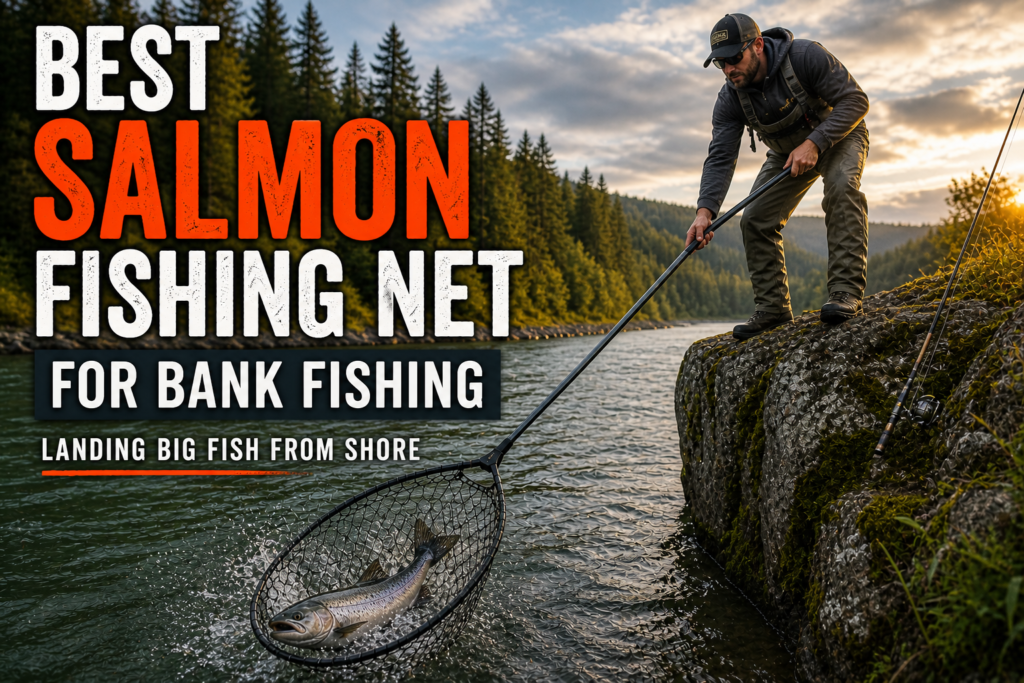
Choosing the best salmon fishing net for bank fishing matters because salmon are big, heavy animals. A solid Chinook at your feet is nothing like landing a trout in a small creek. From the bank you might be standing above the water on rocks, gravel, riprap, or a steep edge. You may need real reach. You probably need a bigger hoop than you think. And if the fish is wild and has to go back, you want a net that’s actually easy on it too.
For bank fishing specifically, I want a salmon net with an oblong hoop, a deep bag, coated or rubber-style mesh, and a long or adjustable handle. A small round trout net is easy to carry, and completely wrong for the job when a big Chinook is rolling at the bank.
If you’re building out your whole salmon setup, my complete salmon fishing setup for rivers covers the full rod, reel, line, and tackle system. This guide is focused entirely on the net, because that final ten feet of the fight is where more fish are lost than most people realize.
One thing I’d genuinely recommend if you have the chance is to walk into a sporting goods store and put your hands on a few nets before you buy. Look at the hoop size, feel the handle, and honestly picture trying to scoop a big Chinook with it from a rocky bank. Some nets look huge online and feel surprisingly small in person. Some look awkward in photos but make total sense once you’re holding them.
That said, not everyone has that option, and plenty of stores don’t carry salmon-sized nets anyway. If you’re shopping online, this guide is the next best thing.
Quick Answer: What Is the Best Salmon Net for Bank Fishing?
The best salmon net for bank fishing is a large landing net with an oblong hoop, a deep coated or rubber-style bag, a strong frame, and a long or adjustable handle.
For Chinook specifically, I’d look for a hoop around 26 x 34 inches or larger, a deep bag, and a handle that gives you at least four to seven feet of reach depending on where you fish. If you regularly stand on steep banks, riprap, or rocky edges, a telescoping handle isn’t optional. It’s necessary.
My ideal salmon net for the bank has:
- An oblong hoop instead of a small round one
- A deep bag that can actually hold a big fish
- Coated or rubber-dipped mesh to protect fish and reduce hook tangles
- A strong aluminum frame
- A long or adjustable handle
- Enough reach to net fish from higher or awkward bank positions
The worst time to discover your net is too small is when a salmon is already tired, rolling, and almost within reach.
Table of Contents
Best Salmon Fishing Nets for Bank Fishing
I’m not going to try to list every salmon net available online. I’d rather keep this focused on options that actually make sense for bigger fish, real bank access situations, and the kind of landing problems you actually run into chasing Chinook from shore.
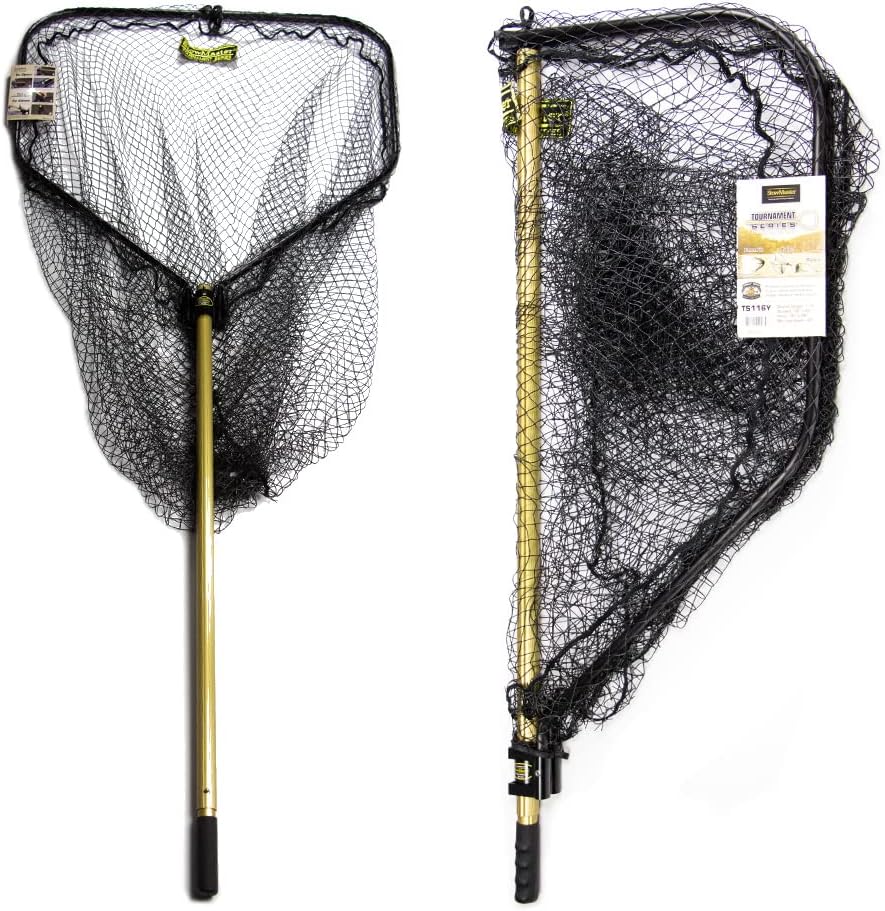
Best Heavy-Duty Salmon Net for Big Chinook: StowMaster TS116Y Tournament Series Landing Net
The StowMaster TS116Y is technically marketed as a muskie net, but the size and design make it one of the most serious options out there for big Chinook from the bank. That is exactly why it is at the top of this list.
The hoop measures 36 x 38 inches with a 48-inch deep bag. To put that in perspective, that is a lot of room. When you’ve got a 30-pound Chinook rolling sideways at your feet, you want that margin. A small round net in that situation is a disaster waiting to happen.
The handle is the other big reason this net makes sense for bank anglers. It telescopes for extended reach and has an overall length of 116 inches, nearly ten feet. If you’re standing above the water on rocks or riprap and need to reach down to a fish, this is the kind of net that actually gives you that option instead of forcing you to scramble for a foothold while a tired fish recovers and bolts.
Specs:
- 36″ x 38″ hoop
- 48″ deep net bag
- 116″ overall length
- Telescoping handle
- Handle slides into the net for storage
- Aircraft-quality aluminum alloy handle, hoop, and yoke
- Non-slip and non-twist handle extension
- Rubber-dipped nylon netting
- Made in USA
My take:
This is the serious big-fish option. It is larger than some anglers will want to carry on a long walk-in trip, but if you’re targeting big Chinook from the bank and you want maximum reach and real scooping room, this checks every box. I’d rather carry a slightly heavier net and land my fish than carry a light net and watch it come off at my feet.
Best Big Hoop Salmon Net with Extra Leverage: Frabill Trophy Haul Predator Fishing Net
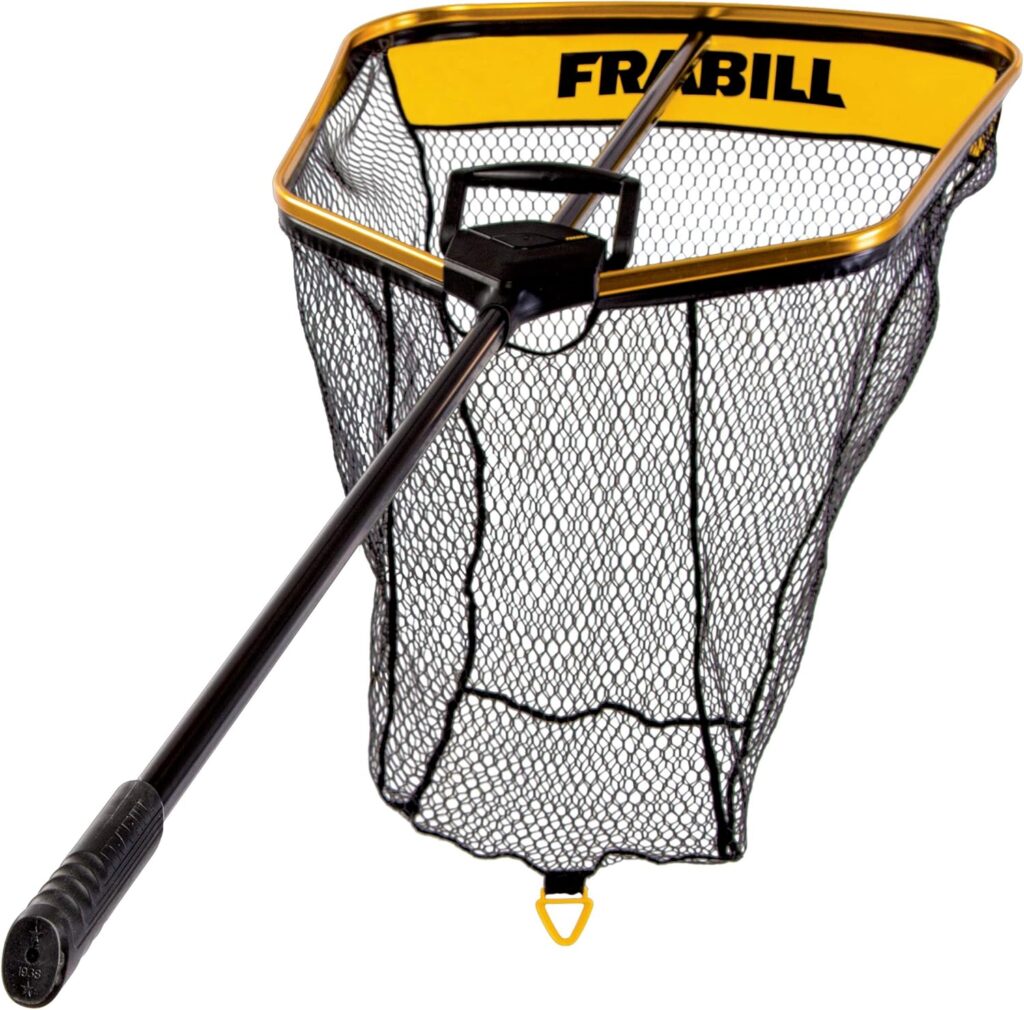
The Frabill Trophy Haul Predator is a large salmon-capable net that makes sense if you want a serious hoop and a strong handle without going quite as massive as the StowMaster.
The hoop comes in at 27 x 30 inches, which is genuinely salmon-sized, and the reinforced 72-inch sliding handle gives you solid reach from rocks, gravel bars, or uneven bank edges. Where this net stands out is the extra handle near the yoke. That detail might not sound like much until you’ve got a heavy, thrashing Chinook in the bag and you’re trying to maintain control on uneven footing. Extra leverage at that point is not a small thing.
The netting is conservation-style and tangle-free, which I appreciate. The lighted yoke feature is not something I’d specifically seek out because I’m not usually netting salmon in the dark, but the hoop size, handle length, and fish-friendly mesh are all worth the price of admission.
Specs:
- 27″ x 30″ hoop
- 72″ reinforced sliding handle
- Conservation-style tangle-free netting
- Flat-bottom net design
- Extra handle near the yoke for leverage
- Lighted yoke and reflective hoop
My take:
This is the right call if you want a large salmon net with a manageable hoop size and that extra leverage handle at the yoke. It is not trying to be the biggest net on the market. It is trying to be a practical, well-built salmon net with smart features. It delivers on that.
Best Mid-Budget Salmon Net: Beckman Coated Landing Net
The Beckman Coated Landing Net is the mid-budget option I’d point someone toward if they want a legitimate salmon net without going all the way up to the heavy-duty choices above.
At around the $130 range, it is not cheap, but it is less expensive than the other two and still has the features that actually matter for salmon bank fishing. The 26 x 34 inch oblong hoop is the right shape for a long fish. The four to seven foot adjustable handle gives you real reach from the bank. And the 32-inch deep PVC-coated bag is a big deal. Coated mesh on a salmon net reduces hook tangles dramatically compared to plain rope-style netting, and that difference adds up over a season.
Beckman is a brand that has earned its reputation in the salmon and steelhead world, and this net feels like a practical, no-nonsense middle ground. Not as massive as the StowMaster, not as feature-heavy as the Frabill, but the hoop shape, coated bag, adjustable handle, and reinforced aluminum build all check the right boxes.
Specs:
- 26″ x 34″ hoop
- 4′ to 7′ adjustable handle
- 32″ deep PVC-coated net bag
- Reinforced aluminum yoke and frame
- Internal Y-Bar construction
- Reinforced aluminum handle
- Quick-Connect pin
- Coated nylon net bag
- Lifetime limited warranty
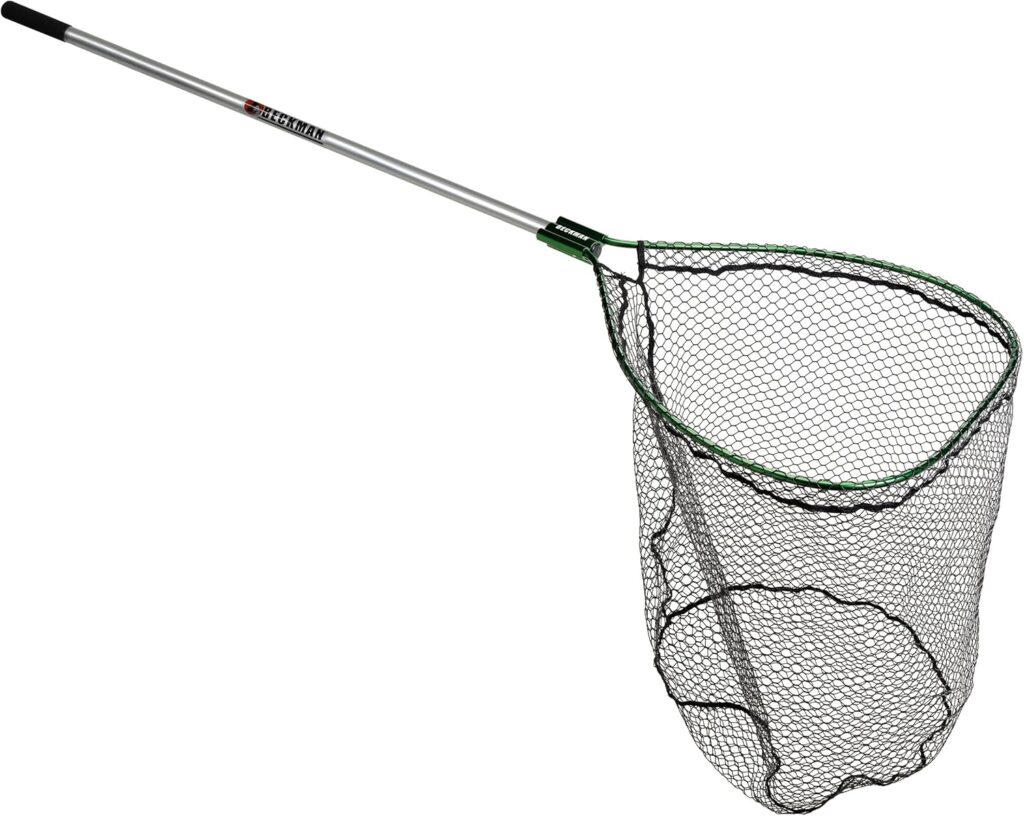
My take:
This is probably the most practical middle-ground salmon net of the three. It has everything you actually need: the right hoop shape, real handle reach, coated netting, and a brand name that has been trusted in Northwest salmon and steelhead fishing for a long time. If I wanted a strong salmon net with good reach and did not want to carry an oversized monster net all day, this is where I’d land.
What Makes a Good Salmon Fishing Net?
A good salmon net does not need to be fancy, but it does need to be big enough and strong enough for the fish you’re actually trying to land.
For bank fishing specifically, I look at five things:
- Hoop size
- Net shape
- Bag depth
- Handle length
- Mesh material
A net can look solid online and still be completely wrong for salmon. A lot of landing nets are sized for trout, bass, or general freshwater fishing. They work great for smaller fish and are completely outmatched the moment a big Chinook rolls at the bank.
Salmon are long. They’re strong. And when they get close to shore they often roll, turn sideways, kick hard, or make one last desperate run. The net has to be ready for all of that.
The net is part of the system, not an afterthought. My bank fishing for salmon guide goes into positioning and approach from shore, but once you actually hook a fish, the net becomes one of the most important pieces of gear you brought.
What Size Net Do You Need for Salmon?
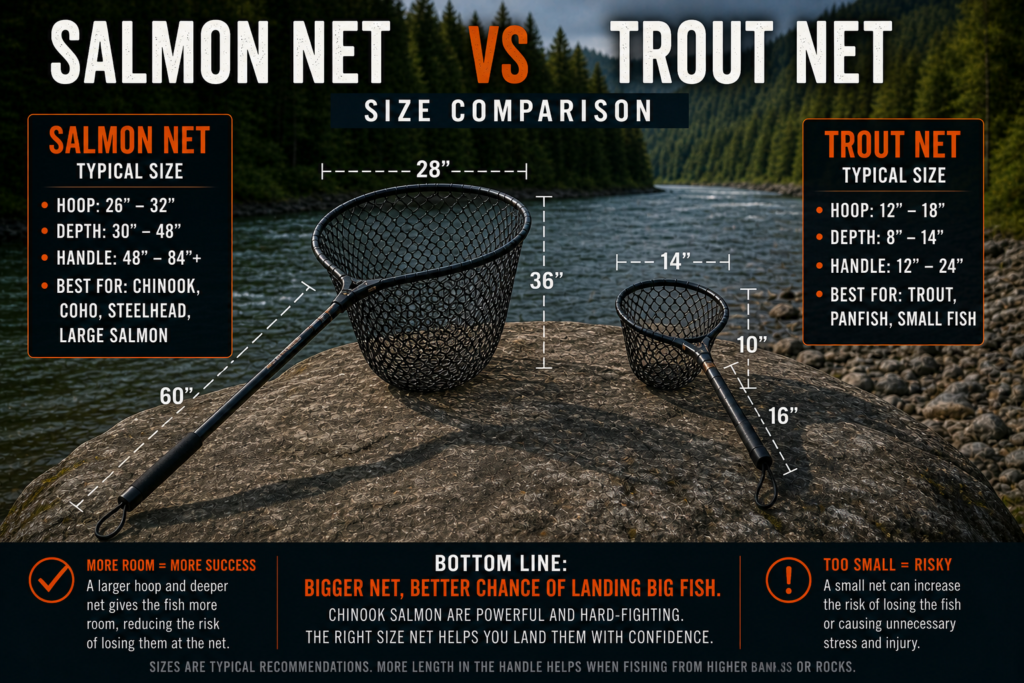
For salmon, especially Chinook, I’d rather have too much net than not enough.
A small trout net is easy to carry, but it can make landing a big salmon genuinely miserable. If you have to aim perfectly just to get half the fish in the hoop, the net is too small. It is that simple.
For bank fishing, I’d look for:
- Hoop width around 26 to 36 inches
- An oblong shape when possible
- A bag depth of at least 30 inches
- A handle in the four to seven foot range
- A longer handle if you regularly fish steep or rocky banks
A bigger hoop gives you room to lead the fish in head-first without needing a perfect angle. A deeper bag keeps the fish contained once it is inside. A longer handle bridges the gap when you cannot get all the way down to the water’s edge.
If you’re asking yourself whether a net is big enough for Chinook, it probably is not the net I’d choose.
That does not mean every angler needs the largest net ever made. If you’re fishing smaller rivers with easy gravel bar access, a mid-sized salmon net will get the job done. But on bigger water, steep banks, or anywhere landing is awkward, hoop size and handle length matter a lot.
Why I Prefer Rubber or Coated Mesh for Salmon
For salmon and steelhead, I want rubber mesh, rubber-coated mesh, or coated nylon over plain rope-style nylon netting, and I feel pretty strongly about that.
The first reason is fish protection. Salmon and steelhead have a slime coating that plays a real role in their health, and that coating matters even more on a wild fish that has to go back. A rough nylon net is harder on that slime layer. If I’m releasing a wild fish, I want it handled as carefully as possible, and a coated mesh net is part of that.
The second reason is purely practical: hooks do not tangle in coated mesh the way they do in plain nylon rope netting. If you’ve ever landed a salmon on a treble hook or a spinner and then spent the next five minutes fighting the hook out of the net while your bait washes away and your partner loses patience, you know exactly what I’m talking about. It wastes time, it can damage the net, and it is completely avoidable.
Plain nylon nets are cheaper and lighter, and they’re fine for a lot of fishing. But for salmon fishing with bigger hooks and bigger gear, coated or rubber-style mesh is worth it every time.
Oblong Nets vs Round Nets for Salmon
For salmon I prefer an oblong or teardrop-shaped hoop, and it is not really a close call.
Salmon are long, heavy fish. That extra length in the hoop gives you more room when the fish is coming in head-first, and it gives you a little forgiveness when the fish rolls, turns, or comes in at an awkward angle. From the bank where you might be reaching down or fishing from an uneven edge, that margin matters.
Round nets are not useless. But they are not what I’d choose for salmon bank fishing. When a big Chinook is rolling at your feet on a rocky bank, the last thing you want is to be trying to thread a long fish through a small round hoop.
More room in the hoop means more chances to finish the job cleanly.
Long Handle vs Short Handle Salmon Nets
For bank fishing, a long or adjustable telescoping handle is not a luxury. It is a practical necessity a lot of the time.
There are plenty of bank situations where you’re standing above the water on a rock ledge, steep bank, riprap edge, or gravel drop-off, and the fish is still a few feet below you. A short handle in that situation means you’re either scrambling for a different position or hoping the fish holds still while you figure it out. Neither is a good plan.
A telescoping handle solves this cleanly. You keep the net shorter while you’re walking, then extend it when you need reach at the water. The StowMaster and the Beckman both handle this well. The StowMaster gives you extreme overall length for serious reach situations, and the Beckman gives you a practical four to seven foot adjustable range that covers most bank fishing scenarios.
Short handles only make sense when the fish is right at your feet on a flat, easy bank. The moment you’re on rocks, riprap, or standing above the water, you’ll wish you had more reach.
How to Net a Salmon from the Bank
A good net helps a lot, but how you use it matters just as much.
The biggest mistake is chasing the fish around with the net. That almost always spooks the fish, triggers one last run, and turns a controlled landing into a scramble. The netter’s job is not to chase the salmon. It is to hold the net steady and let the angler lead the fish into it.
Here’s how it should go:
Fight the fish until it is genuinely tired and controllable. Keep steady pressure and avoid high-sticking the rod when the fish is close. That is a great way to break a rod tip or pop a hook at the worst possible moment. Get the net in the water before the fish is right on top of you so there is no last-second splashing and scrambling. Lead the salmon in head-first toward the hoop. Keep the net low and still. Scoop only when the fish is fully committed and lined up. Then lift smoothly once it is fully inside the bag.
Head-first is almost always better. If you try to scoop from behind, the fish can kick forward and shoot right out. You’ll want to say some words you’d regret in polite company.
This applies whether you’re float fishing, drift fishing, or throwing hardware. If you’re still working on the techniques that get fish to the bank in the first place, my guides on how to drift fish for salmon and how to fish salmon with lures both cover the presentation side of things.
The net closes the deal. Make sure you know how to use it before the moment arrives.
Do You Always Need a Net for Salmon?
Not always, but for bank fishing, I almost always want one with me.
There are gravel bars where you can carefully beach a hatchery fish in shallow water if conditions allow and retention is legal. But that is not the situation you’re dealing with most of the time.
A net becomes much more important when you’re fishing steep banks, riprap, deep edges, brushy banks, fast current, rocky shorelines, or anywhere a wild fish might need to be released cleanly. If you’re releasing a fish, a net lets you control it without dragging it onto rocks, gravel, or mud. If you’re keeping a legal hatchery fish, a net still prevents that last-second heartbreak when the hook pops right at your feet.
Always check your local regulations for retention rules, hatchery versus wild rules, and any specific handling requirements. Salmon regulations change by river, season, and species, and it is your responsibility to know what applies where you’re fishing.
Common Mistakes When Choosing a Salmon Net
A net is simple gear, but people still end up with the wrong one all the time.
Buying a Trout Net
The most common mistake on this list. A trout net looks fine until there’s a Chinook halfway in it and halfway out of it. Salmon need more hoop room, more bag depth, and more handle strength. It is a different fish.
Choosing a Handle That Is Too Short
Short handles work from boats and perfect gravel bars. They do not work when you’re standing above the water and the fish is several feet below you. Bank anglers need to think about reach before they buy.
Using Plain Nylon Mesh
Plain rope-style nylon is rougher on fish and more frustrating with hooks. For salmon and steelhead, coated, rubber-dipped, or rubber-style mesh is worth the upgrade every time.
Picking a Net That Is Too Round
Round nets can work, but oblong nets give you more room for a long fish coming in at an imperfect angle. Extra hoop length is insurance.
Trying to Net a Green Fish
A green fish is a fish that is not ready. If you push the net at a salmon too early, it bolts. Fight the fish until it is controlled, then lead it in.
Scooping Tail-First
Tail-first netting gives the fish a perfect chance to kick forward and escape. Lead it head-first, every time.
Leaving the Net in the Truck
This one sounds obvious. It still happens. The best salmon net ever made does not help if it is sitting in the parking lot while your fish is rolling at the bank. If you brought the net, keep it with you.
Final Thoughts
A salmon net is not the most exciting piece of gear to think about until a big fish is finally at the bank and everything comes down to whether you can actually land it.
For bank fishing, I want a net with a large oblong hoop, a deep bag, coated or rubber-style mesh, a strong frame, and a long or adjustable handle. I want a net that can handle a real Chinook without turning into a tangled mess every time a hook touches the bag.
The StowMaster is the heavy-duty option for anglers who want maximum reach and maximum hoop room for big Chinook. The Frabill gives you a large salmon-capable hoop and that smart leverage handle at the yoke. The Beckman is the practical mid-budget choice with a proven reputation in Northwest salmon and steelhead fishing.
If I’m standing on a river bank and a Chinook rolls at my feet, I want a net that gives me a real shot at finishing the job cleanly. That is the whole point.
If you’re still building the rest of your system, my complete salmon fishing setup for rivers and bank fishing for salmon guides are good next reads.
FAQ
What size net is best for salmon fishing?
For salmon, especially Chinook, look for a hoop around 26 to 36 inches wide with a deep bag. Smaller trout nets are usually too small for big salmon, and from the bank an oblong hoop gives you more room to lead the fish in head-first without needing a perfect angle.
What is the best salmon fishing net for bank fishing?
A large oblong net with a deep coated or rubber-style bag, strong frame, and long or adjustable handle is the best salmon fishing net for bank fishing. Bank anglers often need extra reach from rocks, gravel bars, steep banks, or riprap, so handle length matters almost as much as hoop size.
Do I need a net for salmon bank fishing?
In most bank fishing situations, yes. A net helps prevent last-second losses and makes it easier to control salmon near rocks, steep edges, brush, or fast current. It is especially important if you hook a wild fish that needs to be released as carefully as possible.
Is rubber mesh better for salmon nets?
Yes, rubber mesh, rubber-coated mesh, or coated nylon is generally better than plain rope-style nylon for salmon. It is easier on the fish’s slime coating, tangles hooks far less, and is less frustrating when you’re dealing with bigger salmon hooks, spinners, spoons, or bait rigs.
How long should a salmon net handle be?
For bank fishing, four to seven feet is a solid starting point. If you fish steep banks, rocks, or riprap regularly, a telescoping handle is worth having so you can extend when you need the extra reach.
Can I use a trout net for salmon?
A trout net is usually too small, especially for Chinook. It might work in perfect conditions with a smaller fish, but a small hoop and shallow bag will make landing a big salmon from the bank much harder than it needs to be.
What is the best way to net a salmon?
Lead it head-first into the net when it is ready and tired. Keep the net low in the water, hold it still, and do not chase the fish. Scoop once the salmon is fully committed and inside the hoop, then lift smoothly.
Should I net a salmon head first or tail first?
Head-first, every time. Scooping from behind gives the fish a chance to kick forward and escape. Lead it toward the hoop, keep the net steady, and scoop once it is fully in.