Affiliate Disclosure: This post may contain affiliate links. As an Amazon Associate, I may earn from qualifying purchases at no extra cost to you.
Wading boots are one of those pieces of salmon fishing gear that people don’t think about enough until they slip on a rock, twist an ankle, or realize their cheap boots are falling apart halfway through the season.
If you fish salmon from the bank with stockingfoot waders, your boots matter a lot. They need to fit over your wader booties, drain water quickly, grip slick rocks, handle mud and gravel, and give you enough support to walk uneven riverbanks safely. A lot of that safety piece gets overlooked when people are buying gear, and it shouldn’t.
For most salmon anglers, I’d rather see you put money into a solid pair of wading boots than try to get by with old hiking boots. Hiking boots aren’t designed to drain properly, fit over stockingfoot wader booties, or grip wet river rock the same way a purpose-built wading boot does.
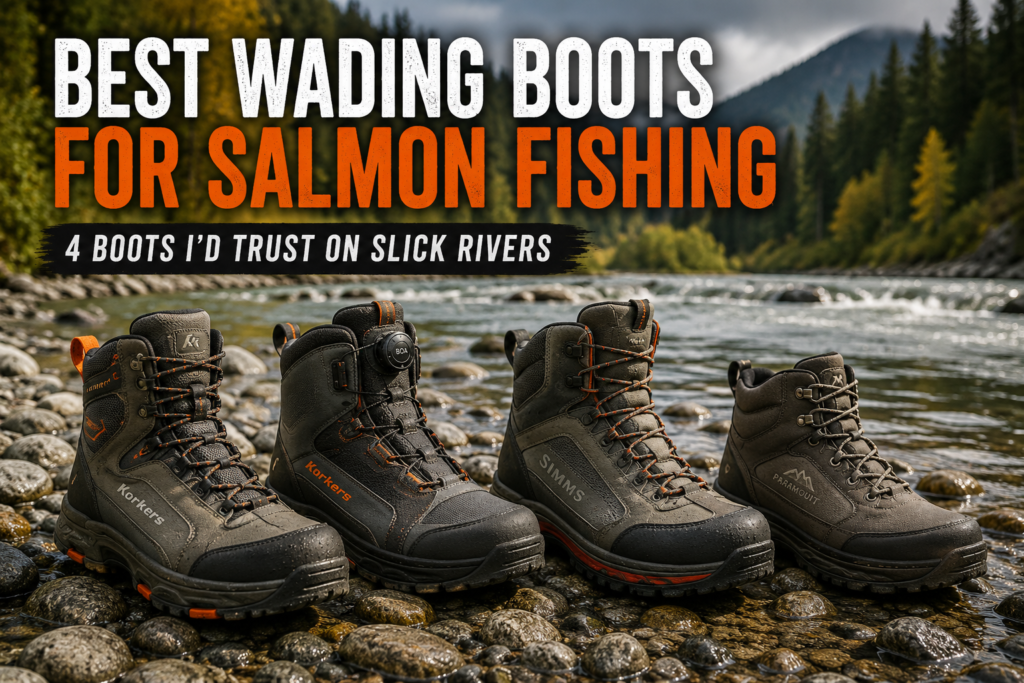
My top pick is the Korkers Buckskin Wading Boot because it’s the pair I personally use. I’ve had mine for about four years now, and they’re still going strong. They’re comfortable, durable, and sit in a middle price range where you get a serious boot without jumping into premium territory.
Quick Picks: Best Wading Boots for Salmon Fishing
Best Overall: Korkers Buckskin Men’s Wading Boots
Best Upgrade: Korkers Darkhorse Wading Boots
Best Premium Non-Korkers Option: Simms Freestone Rubber Wading Boot
Best Budget Option: Paramount Outdoors Stonefly Wading Boot
Table of Contents
Best Wading Boots for Salmon Fishing
| Pick | Boot | Best For |
|---|---|---|
| Best Overall | Korkers Buckskin | Most salmon anglers using stockingfoot waders |
| Best Upgrade | Korkers Darkhorse | Anglers who want BOA lacing and upgraded fit |
| Best Premium Non-Korkers | Simms Freestone Rubber Boot | Anglers who want a higher-end Simms option |
| Best Budget | Paramount Outdoors Stonefly | Beginners who want a lower-cost wading boot |
Why Wading Boots Matter for Salmon Fishing
Salmon fishing from the bank is rough on your feet, and the terrain doesn’t give you much room for error.
You’re walking over wet rocks, loose gravel, mud, roots, riprap, steep banks, and uneven river edges. Add current, cold water, and a hooked fish pulling against you, and bad footing can get dangerous fast. A fall in cold current isn’t just embarrassing. On a Pacific Northwest salmon river in October, it can become a serious situation quickly.
Good wading boots help you stay on your feet by providing traction on slick rocks, ankle support on uneven banks, protection for your stockingfoot wader booties, proper drainage after stepping in and out of the river, and stability while you’re fighting or landing fish. They also make long bank walks significantly more comfortable than a cheap or poorly fitting boot.
This is especially important on Pacific Northwest rivers. A lot of salmon water isn’t clean, flat gravel with easy footing. It’s slippery, uneven, muddy, and full of awkward spots where the wrong step matters.
If most of your fishing is from shore, my bank fishing for salmon guide also covers the kind of river access, walking, and footing situations where good boots matter.
If you’re still building out your full setup, read my guide to a complete salmon fishing setup for rivers after this. Boots and waders are only part of staying comfortable and effective on the bank.
Best Overall Wading Boots: Korkers Buckskin
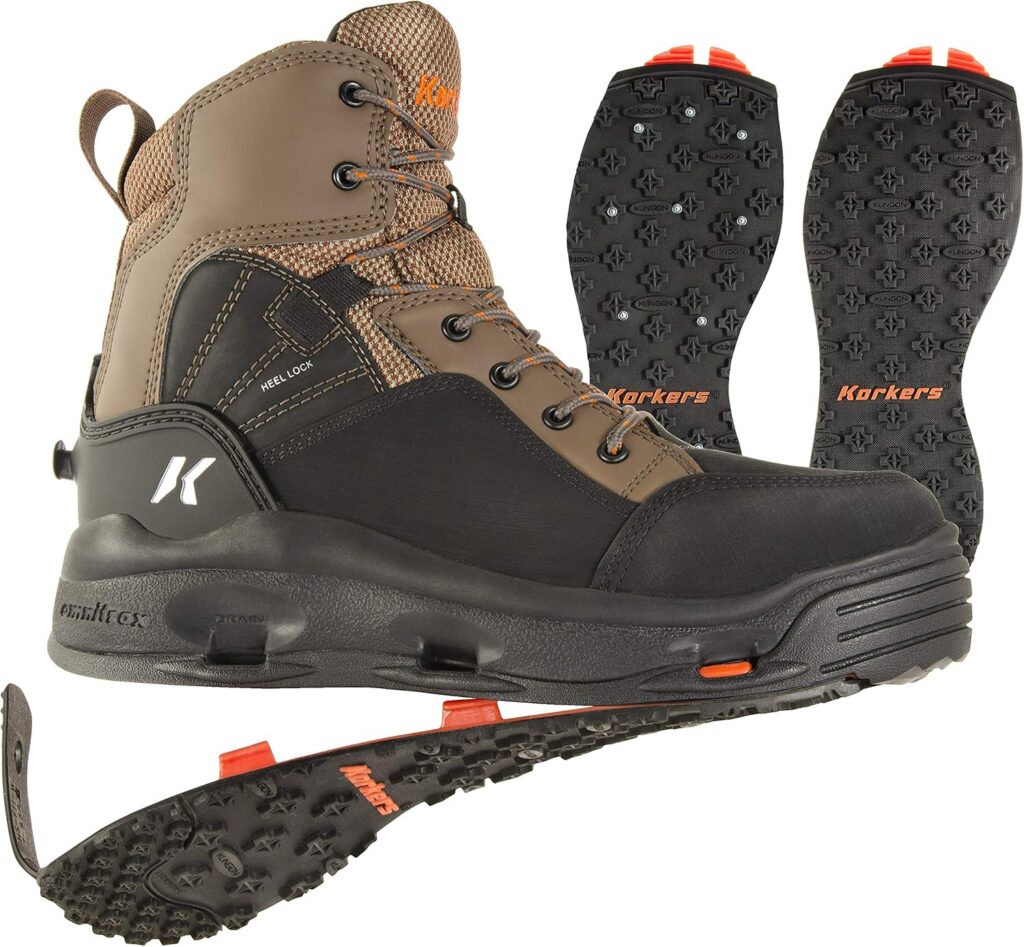
The Korkers Buckskin Men’s Wading Boots are my top pick because they’re the boots I actually use with my stockingfoot waders.
I’ve had my Buckskins for about four years now, and they’re still going strong. They’re comfortable, they’ve held up to regular hard use on salmon and steelhead rivers, and at around $142 they hit a price point that feels genuinely fair for what you get. Not the cheapest option in the lineup, but nowhere near the premium end either.
Korkers is one of the go-to brands for wading boots, and the Buckskin is a good example of why people keep coming back to them. The biggest feature is the OmniTrax interchangeable sole system, which lets you swap traction depending on where you’re fishing and what the conditions look like.
That matters for salmon fishing more than people might expect. Some days you’re walking flat gravel bars. Other days you’re stepping around slick boulders, navigating muddy banks, or crossing wet ledges where extra grip makes a real difference. Having the ability to change soles gives the Buckskin a versatility that a fixed-sole boot just can’t match.
The boot comes with both Kling-On and Studded Kling-On soles right out of the box, which gives you a solid starting setup without needing to buy additional soles immediately. The hydrophobic materials help the boot dry faster after use, which also reduces the chance of transporting aquatic invasive species between waterways.
The construction is built for real river use. Enhanced midsole, scratch rubber toe cap, rubberized anti-abrasion material on the uppers, internal drainage channels, and non-corrosive hardware throughout. Salmon riverbanks are not gentle on gear, and these details add up over a full season.
Specs:
- Price: around $142
- Designed for stockingfoot waders
- OmniTrax interchangeable sole system
- Includes Kling-On and Studded Kling-On soles
- Hydrophobic materials for faster drying
- Scratch rubber toe cap
- Rubberized anti-abrasion material
- Internal drainage channels and midsole ports
- Traditional laces with non-corrosive hardware
- Heel lock for secure fit
My take:
If I were recommending one pair of wading boots to most salmon anglers, this would be it. I use the Korkers Buckskin with my stockingfoot waders, and after four years mine are still comfortable and holding up well. For the price, durability, and interchangeable traction options, they’re the best overall pick in this lineup.
If you’re pairing these with stockingfoot waders, read my guide to the best waders for salmon fishing too. That post explains why I like breathable stockingfoot waders for most bank fishing situations.
If you’re pairing these with stockingfoot waders, read my guide to the best waders for salmon fishing too. That post explains why I like breathable stockingfoot waders for most bank fishing situations.
Best Upgrade Wading Boots: Korkers Darkhorse
The Korkers Darkhorse Wading Boots are the upgrade pick if you like the Korkers system but want a step up from the Buckskin.
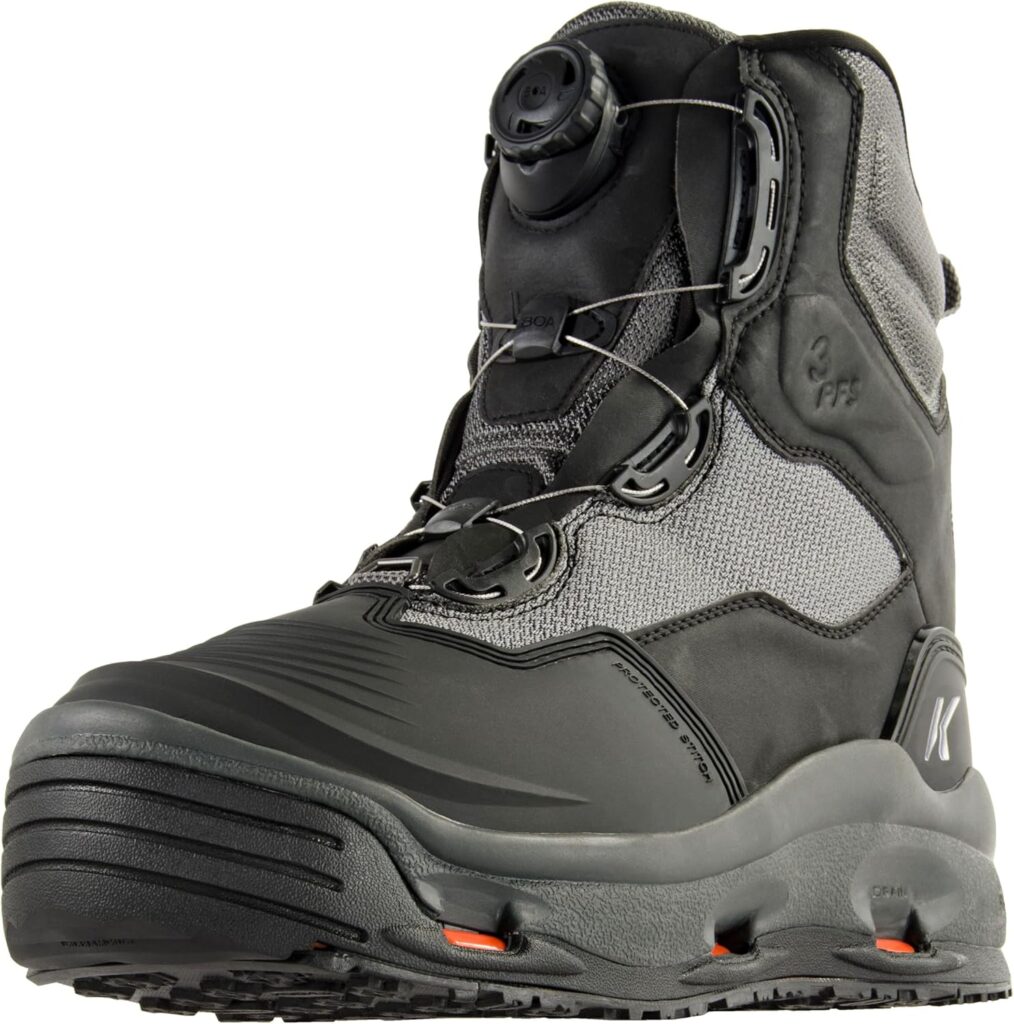
The biggest difference is the BOA M2 lacing system. Instead of traditional boot laces, the Darkhorse uses a dial that lets you tighten and loosen the boot quickly and precisely. BOA systems are known for being reliable under hard use, and when your hands are cold, wet, and covered in bait and river slime, being able to adjust your boots without fighting with wet laces is genuinely useful.
You still get the OmniTrax interchangeable sole system, which is one of the main reasons to buy Korkers in the first place. This model includes interchangeable felt and Kling-On soles, giving you traction flexibility for different river conditions.
One important thing to know before buying: always check your local regulations before fishing felt soles. Felt grips well in certain slick-rock situations, but some waters restrict or prohibit felt because it can harbor and transport aquatic invasive species between waterways. If felt isn’t allowed where you fish, Korkers sells compatible rubber and studded rubber soles separately that fit the OmniTrax system.
I don’t personally run the Darkhorse myself, but I have a fishing buddy who has been wearing his for close to ten years. He travels and fishes year-round, and his Darkhorse boots are definitely beat up at this point. But they still somehow get the job done, which says a lot about the long-term durability of this boot.
Specs:
- Higher-budget Korkers option
- Designed for stockingfoot waders
- BOA M2 lacing system
- OmniTrax interchangeable sole system
- Includes felt and Kling-On soles
- Hydrophobic abrasion-resistant upper
- Internal drainage channels and midsole ports
- 3PFS Achilles stabilization
- Quick on/off fit adjustment
My take:
The Korkers Darkhorse is the boot I’d look at if you want an upgraded Korkers with BOA lacing. The Buckskin is still my top value pick for most salmon anglers, but the Darkhorse makes sense if you fish a lot, want faster fit adjustment, and want a boot built for long-term hard use.
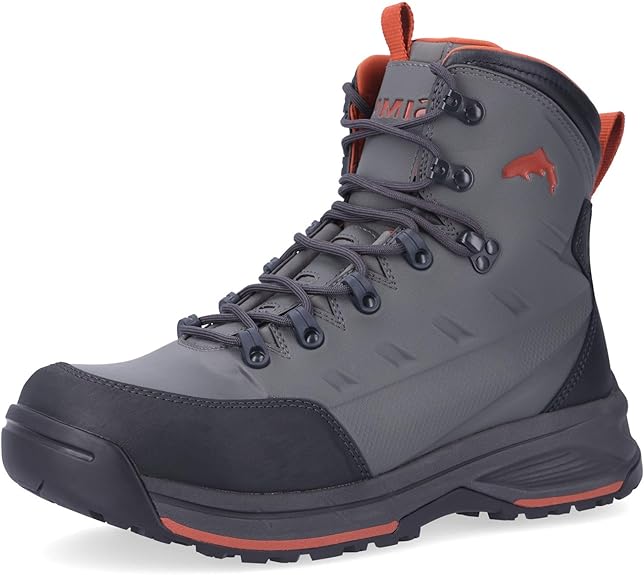
Best Premium Non-Korkers Wading Boot: Simms Freestone Rubber Boot
The Simms Freestone Rubber Wading Boot is the option I’d look at if you want a higher-end boot but don’t want to go with Korkers.
You generally can’t go wrong with Simms products. They’re usually on the higher end of the price range, but the quality backs it up. At around $230, the Freestone Rubber Boot is not cheap, but it gives you a serious stockingfoot wading boot from one of the most trusted names in fishing gear.
The waterproof synthetic scratch leather upper with reinforced toe and heel is exactly the kind of construction I want to see in a salmon wading boot. Riverbanks beat up the front and back of boots faster than most people expect, and reinforcement in those areas extends the life of the boot significantly.
The partial neoprene lining adds comfort and makes the boot easier to get on and off over stockingfoot booties. The dual-density EVA midsole is worth mentioning for bank anglers who walk a lot. Long gravel bar walks in a stiff, unsupportive boot wear on your feet faster than you’d think, and a proper midsole makes a real difference over the course of a full day.
The rubber outsole is compatible with Simms Hardbite Star Cleats, Hardbite Studs, and Alumibite Star Cleats. That matters because plain rubber handles some river conditions well but can struggle on polished, algae-covered rock that’s common on Pacific Northwest salmon rivers. Having the option to add studs or cleats gives you traction flexibility without needing a completely different boot.
Worth noting as well: this boot is crafted without PFAS, which is an environmental consideration some anglers prioritize when choosing gear.
Specs:
- Price: around $230
- Designed for stockingfoot waders
- Waterproof synthetic scratch leather upper
- Toe and heel reinforcement
- Partial neoprene lining
- Dual-density EVA midsole
- Rubber outsole
- Compatible with Simms Hardbite Star Cleats, Hardbite Studs, and Alumibite Star Cleats
- Crafted without PFAS
My take:
The Simms Freestone Rubber Boot is the premium non-Korkers pick. I’d still put the Korkers Buckskin first because I have years of personal use with them, but if you want a high-end Simms option with a rubber sole, stud compatibility, and serious construction, the Freestone earns its price.
Best Budget Wading Boots: Paramount Outdoors Stonefly
HTML Anchor to set on this H2:
best-budget-wading-boots-paramount-outdoors-stonefly
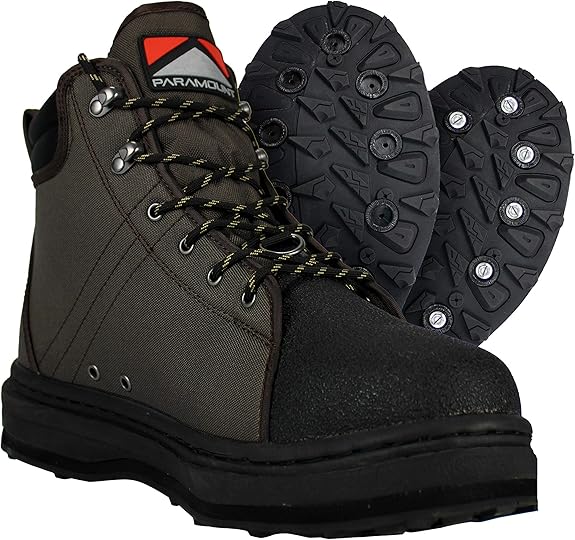
The Paramount Outdoors Stonefly Wading Boot is the budget option in this lineup, and it’s the right answer for newer salmon anglers who need proper wading boots without spending Korkers or Simms money yet.
At around $99, these are the boots I’d point a beginner toward if budget is a real concern. They’re not going to feel as refined as the Korkers or Simms options, and I wouldn’t expect them to hold up to the same years of hard use. But they’re a real wading boot designed for stockingfoot waders, and that matters more than people realize when the alternative is wearing random hiking boots with neoprene booties.
The cleated rubber outsole with recessed stud insert points is a solid traction setup at this price, and the fact that they include steel wading studs in the box means you’re getting functional grip right out of the packaging. You can run them with or without the studs depending on the conditions.
The reinforced Rock Jam toe cap and stiff reinforced midsole give you real protection where riverbanks hit boots hardest. The padded collar helps with ankle comfort on longer walks, and the gravel guard D-ring attachment point is a useful feature for keeping debris out of your booties.
The listing notes that these are sized to fit over stockingfoot wader booties without needing to size up, which is a helpful clarification because wading boot sizing confuses a lot of new anglers.
Specs:
- Price: around $99
- Designed for stockingfoot wader booties
- Cleated rubber outsole
- Recessed stud insert points
- Steel wading studs included
- Can be worn with or without studs
- Reinforced Rock Jam toe cap
- Stiff reinforced midsole
- Reinforced heel pull
- Padded collar
- Gravel guard D-ring attachment point
My take:
The Paramount Outdoors Stonefly is the budget starting point I’d include for new salmon anglers who need proper wading boots without spending premium money. The Korkers Buckskin is a better long-term buy if the budget allows, but at around $99 with studs included, the Stonefly is a real wading boot that gives beginners a legitimate foundation to build from.
Rubber vs Felt Wading Boots for Salmon Fishing
Rubber and felt both have their place, but for most salmon bank anglers, I lean toward rubber or studded rubber as the safer default.
Felt grips well on certain slick rock surfaces, and in the right conditions it can feel noticeably better than plain rubber. The problem is that felt can be restricted or prohibited on many Pacific Northwest waters because it can harbor and transport aquatic invasive species like New Zealand mudsnails and whirling disease spores between waterways. Felt is also inconsistent in mud, snow, and on long bank walks away from the river, where it doesn’t perform nearly as well as rubber.
Rubber is more versatile across different conditions, easier to clean properly between waterways, and generally a safer default if you fish multiple rivers in a season. The downside is that plain rubber can be slippery on polished, algae-covered rock, which is exactly the kind of bottom you encounter on a lot of Pacific Northwest salmon rivers.
That’s where studs come in. Studded rubber is the best all-around traction setup for most salmon bank fishing. You get the versatility and cleanability of rubber with enough bite to handle slick rock situations that would be sketchy on a plain rubber sole.
A simple framework for thinking about it:
- Plain rubber: good for easier banks and general walking
- Studded rubber: best all-around choice for most salmon rivers
- Felt: can grip well in specific situations, but always check local regulations first
- Interchangeable sole systems: best option if you fish a wide variety of rivers and want to adapt your traction to the conditions
Should You Use Studded Wading Boots?
For salmon bank fishing, studs are worth having in most situations.
A lot of salmon rivers have slick rocks, algae-covered ledges, muddy banks, and uneven footing where plain rubber loses traction quickly. Studs bite into those surfaces and give you much more confidence on footing that would otherwise keep you tentative and slow.
The tradeoff is that studs are noisy on hard surfaces, can scratch boat decks if you’re ever on a guided trip, and feel awkward on pavement or concrete. If you fish primarily from a boat or spend a lot of time on hard surfaces, studs all the time can be inconvenient.
For bank fishing specifically, I want the option. That’s one of the main reasons interchangeable sole systems or boots with stud compatibility make so much practical sense for salmon anglers who fish diverse water.
For more bank-specific gear and safety considerations, my guide to how to catch Chinook salmon from the bank covers the kind of river situations where footing and mobility matter.
For more bank-specific gear and safety considerations, my guide to how to catch Chinook salmon from the bank covers the kind of river situations where footing and mobility matter.
What Size Wading Boots Should You Buy?
Wading boot sizing varies by brand, and it’s worth paying attention to before you order.
Some boots are sized to fit over stockingfoot wader booties without any adjustment. Others recommend sizing up one full size to account for the extra bulk of the bootie underneath. Always check the brand’s specific sizing chart and read recent reviews from other buyers before ordering, since sizing advice on wading boots can save you the hassle of a return.
The boot should have enough room for your stockingfoot wader bootie, a good pair of wool or synthetic wading socks underneath, and enough space for cold-weather layering if you fish in cold temperatures. It should not feel sloppy or allow your foot to slide around inside, which reduces stability and creates hot spots on longer walks.
For salmon fishing specifically, a secure heel fit and snug ankle are the most important parts of the fit equation. Heel lift inside the boot while walking on uneven ground is a sign the boot is too big and will cause problems over a long day.
Can You Use Hiking Boots With Stockingfoot Waders?
You can in a pinch, but I wouldn’t make it your regular setup.
Hiking boots aren’t designed to fit cleanly over neoprene stockingfoot wader booties. Most hiking boot uppers are too narrow in the ankle and forefoot to accommodate the bootie without compressing it uncomfortably. They also don’t drain the same way a wading boot does, so water that gets in sits in the boot instead of flushing out. And the soles, while grippy on dry trail surfaces, aren’t designed for wet river rock the way wading boot soles are.
If you’re spending real money on stockingfoot waders, buy proper wading boots to go with them. The investment makes the whole system work the way it’s supposed to.
Wading Boots vs Wet Wading Shoes
This post is specifically about wading boots for stockingfoot waders, which is the standard setup for most bank salmon fishing.
Wet wading shoes are a different category entirely. They’re used when you’re fishing without full waders and expect your feet to get wet, usually during warmer summer or early fall conditions when the water temperature makes wet wading comfortable.
For the fall and winter conditions most Northwest salmon fishing happens in, proper wading boots with stockingfoot waders are the right setup. Wet wading can make sense in specific warmer-weather situations, but it’s a separate conversation.
My Recommendation
If I had to pick one pair for most salmon anglers, I’d go with the Korkers Buckskin.
That’s not just a spec-sheet decision. It’s because I actually use them. Mine have lasted four years, they’re comfortable all day, and they work well with my stockingfoot waders across different river conditions. The interchangeable sole system is the feature I’d miss most if I switched to a fixed-sole boot.
The Korkers Darkhorse is the right upgrade if you want BOA lacing and a more premium Korkers fit system. The Simms Freestone Rubber Boot is the best option here if you want a high-end non-Korkers boot with stud compatibility and Simms construction. The Paramount Outdoors Stonefly is the right call for beginners who need a real wading boot but want to stay near the $100 range.
For most salmon bank anglers, I’d start with the Korkers Buckskin and only move up if you know you specifically want the BOA system or a particular premium brand.
Final Thoughts
Wading boots aren’t the flashiest piece of salmon fishing gear, but they’re one of the most important from a practical and safety standpoint.
A good pair keeps you upright on slick rock, protects your waders from abrasion, supports your ankles on uneven banks, and makes long days on the river easier on your feet. That matters more than people realize until they’ve had a bad experience with cheap or unsuitable footwear on a rough salmon river.
For my money, the Korkers Buckskin is the best overall pick because it gives you durability, comfort, interchangeable traction, and proven long-term performance at a fair price point.
If you fish salmon from the bank with stockingfoot waders, don’t treat boots like an afterthought. They’re part of your safety system just as much as your wading belt.
FAQ: Best Wading Boots for Salmon Fishing
What are the best wading boots for salmon fishing?
The best wading boots for salmon fishing have strong ankle support, good traction on slick rock, fast drainage, durable construction, and a secure fit over stockingfoot wader booties. My top pick is the Korkers Buckskin because I’ve used mine for about four years, and they’re still comfortable and holding up well.
Are Korkers wading boots good for salmon fishing?
Yes, Korkers wading boots are a great choice for salmon fishing. The interchangeable OmniTrax sole system is especially valuable for salmon anglers who fish different types of rivers and want the flexibility to adapt their traction to changing conditions.
Are the Korkers Buckskin boots worth it?
Yes. I’ve used my Korkers Buckskin boots for about four years with regular hard use on salmon and steelhead rivers, and they’re still going strong. For the price, durability, comfort, and interchangeable sole system, they’re a solid long-term buy.
Are BOA wading boots better than laces?
BOA wading boots are easier and faster to adjust, especially when your hands are cold and wet. Traditional laces still work fine, but BOA is a real convenience upgrade for anglers who fish in cold conditions regularly. The Korkers Darkhorse is a good example of a well-built BOA wading boot.
Are rubber or felt wading boots better for salmon fishing?
For most salmon anglers, rubber or studded rubber wading boots are the safer all-around choice. Felt can grip well on certain slick rock, but it may be restricted or prohibited on some waters because of invasive species concerns. Always check local regulations before using felt soles on any river.
Should I use studded wading boots for salmon fishing?
or most salmon bank fishing, yes. Studded wading boots add meaningful grip on slick rocks, algae-covered ledges, and muddy banks. They’re not ideal on hard surfaces or boat decks, but for bank fishing, they’re worth having in most situations.
Can I wear hiking boots with stockingfoot waders?
You can wear hiking boots with stockingfoot waders in a pinch, but it’s not the right setup for regular use. Hiking boots don’t fit cleanly over neoprene booties, don’t drain properly, and don’t grip wet river rock the way purpose-built wading boots do. If you’re wearing stockingfoot waders, use proper wading boots.
Do wading boots keep your feet dry?
No. Wading boots don’t keep your feet dry on their own. They’re designed to be worn over stockingfoot waders, which are what actually keep water out. The boots provide support, traction, protection for your waders, and drainage.
What size wading boots should I buy?
Check the brand’s sizing chart before ordering, since sizing varies. The fit should accommodate your stockingfoot wader bootie and a pair of wading socks without feeling sloppy. A secure heel fit with no lift during walking is what you’re looking for.
Are wading boots necessary for salmon fishing?
If you’re wearing stockingfoot waders, then yes. Wading boots protect your waders from abrasion, support your ankles on rough bank terrain, drain water properly, and give you far better traction on slick riverbanks than any substitute. For bank salmon fishing, they’re a core piece of safety gear, not an optional accessory.