Affiliate Disclosure: Some of the links below may be affiliate links. As an Amazon Associate, I may earn from qualifying purchases at no extra cost to you. I only recommend gear that makes sense for this style of fishing and fits the way I would actually approach salmon fishing in Northwest rivers.
Learning how to catch Chinook salmon from the bank does not require a secret bait, a magic hole, or some technique nobody else knows about.
Most of the Chinook I’ve seen consistently caught from shore come down to the same basic things done well: fishing the right water, getting the presentation deep enough, using gear that can actually handle a big salmon, and staying patient when the bite is slow.
That is it.
The anglers who figure those things out catch more fish than everyone else. It really is that simple, and that hard.
Chinook are not easy fish. They are big, stubborn, and a lot of the time they are not chasing anything down out of excitement. You usually need to put your bait, lure, or drift rig right in their lane, close enough that the fish reacts, gets annoyed, or eventually just decides to eat it.
That is what this guide is about.
This is not meant to replace every detailed guide on the site. Think of it as the full beginner game plan: where to fish, which setups work, when bait makes sense, when lures are worth throwing, how deep to go, and the mistakes that cost beginners fish they should have landed.
If you are still building your full rod, reel, line, and tackle system, start with my complete salmon fishing setup for rivers. If you are mostly working out shore access and positioning, my bank fishing for salmon guide is a good place to start there.
Quick Answer: How Do You Catch Chinook Salmon from the Bank?
Fish known travel lanes and holding water with a strong setup, the right depth, and a clean presentation.
For most bank anglers, bait under a float is the best starting point when it is legal and water conditions allow it. Cured salmon eggs, sand shrimp, coon shrimp, and egg-and-shrimp combos are all strong Chinook baits. The key is getting that bait into the right lane and close enough to the bottom without dragging it unnaturally through the zone.
If bait is not producing or you need to cover more water, spinners, spoons, plugs, twitching jigs, and soft beads can all catch Chinook from the bank.
The short version: fish seams, deep slots, tailouts, current edges, and softer lanes beside heavier water. Start close before you cast far. Get your bait or lure down. Use strong line, sharp hooks, and a setup built for big fish. Adjust your depth and casting angle before you start swapping out bait or lures every ten minutes.
Most Chinook are not caught on random long casts. They are caught because a presentation went through the right lane at the right depth.
Table of Contents
Why Chinook Salmon Are Different from Other River Salmon
Chinook are a different animal than most other river salmon, and if you have spent time chasing both coho and kings you already know what I mean.
They are bigger, stronger, and a whole lot more stubborn. Mature Chinook in Northwest rivers can be heavy fish, and even an average king has enough power to expose weak gear fast.
They also tend to hold deeper than coho in a lot of river situations, and they do not always want to chase. A coho might dart across a seam and crush a twitching jig or spinner that came within ten feet of it. A Chinook might sit in a deep slot, watch five decent presentations go by, and finally grab the sixth one because the depth was just a little different or the drift was a little more natural.
That is just the fish.
By the time Chinook are pushing upriver, they are not feeding the same way they did in the ocean. Most river strikes come from aggression, territorial instinct, scent response, or reaction rather than true hunger. That is a critical thing to understand because it explains why presentation, depth, and lane placement matter so much more than simply having the right bait or lure.
You are trying to trigger a response.
That is exactly why depth and location matter more for Chinook than almost anything else.
It is also why I have more confidence in bait when I am specifically targeting kings. A good bait presentation carries scent, sits in the zone longer, and drifts more naturally than most lures. Even though river Chinook are not actively feeding the way ocean fish are, they can still respond to familiar scents like eggs and shrimp.
That instinctive response to scent is one of the main reasons bait keeps producing even when fish are not in a feeding mood.
That does not mean lures do not work. They absolutely do. But when I am starting from scratch on a Chinook river and I want to put the odds in my favor, bait is usually where I begin.
Chinook also expose weak gear in a way that smaller fish just do not. A light rod, a weak leader, a dull hook, an undersized net, you might not notice any of those problems until a big Chinook makes one hard run near the bank and suddenly the problem is very obvious.
If you are still dialing in your setup, my guide on what pound line for salmon fishing is worth reading before you find out the hard way.
Best Bank Fishing Spots for Chinook Salmon
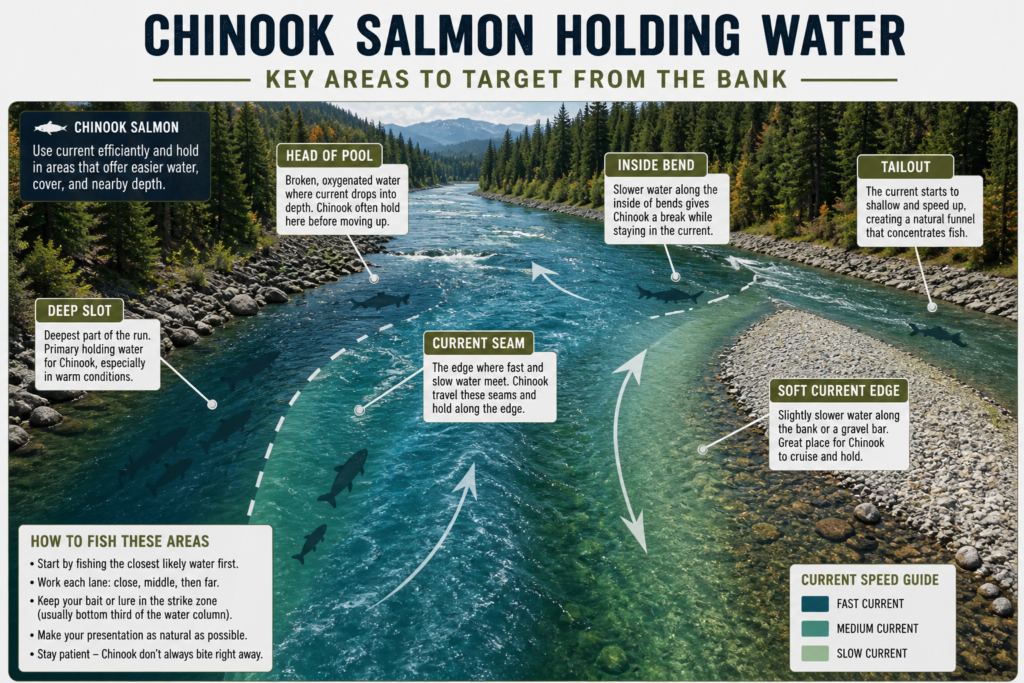
The biggest mistake beginners make is fishing water that looks comfortable to fish instead of water that Chinook actually use.
Kings move upriver using current efficiently. They do not want to fight the heaviest flow all day, so they travel and hold in lanes where they can save energy while staying near moving water. Those lanes are where you need to be putting your presentation.
Good bank fishing spots for Chinook include:
- Deep slots
- Current seams
- Soft current edges
- Tailouts
- Heads of pools
- Inside bends
- Bank-side travel lanes
- Slow pockets beside faster water
- Structure edges near depth
A few things are worth understanding about each.
Deep slots are especially important for Chinook because of their size and preference for deeper, cooler water. In warmer conditions, Chinook will often push into the deepest available water in a run to find more comfortable holding water. If you are fishing warmer weather and not seeing fish in shallower lanes, go deeper before you go anywhere else.
Tailouts can be productive because they act like a natural funnel. The river starts to shallow and tighten, which can concentrate fish moving through.
The heads of pools are worth fishing because the broken, oxygenated water where current drops into depth gives Chinook cover, comfort, and the ability to rest. Fish often stack near the head of a pool, especially on rivers with heavy angling pressure, because the broken water gives them security.
A lot of anglers walk right past productive water because they assume the fish are somewhere far across the river.
That is not always true.
Chinook can travel surprisingly close to the bank along softer inside edges, tailouts, and seams that are well within reach without a long cast.
Fish the close water before you step into it. Work the middle lane. Then cast farther if the far seam or slot actually makes sense from where you are standing.
I would rather make one good cast through a real Chinook lane than throw ten long casts across water that only looks good from a distance.
For a deeper breakdown on seams, slots, tailouts, and travel lanes, read my guide on where to cast for salmon in a river. If you are still learning how to identify good holding water in the first place, my guide on how to read a river for salmon is the right starting point.
Best Setups for Catching Chinook from the Bank
There is more than one way to catch Chinook from the bank, but most effective bank setups fall into three main categories:
- Float fishing
- Drift fishing
- Lure fishing
Each one has its place depending on water depth, current speed, regulations, river pressure, and how active the fish seem on any given day.
Float Fishing Setup
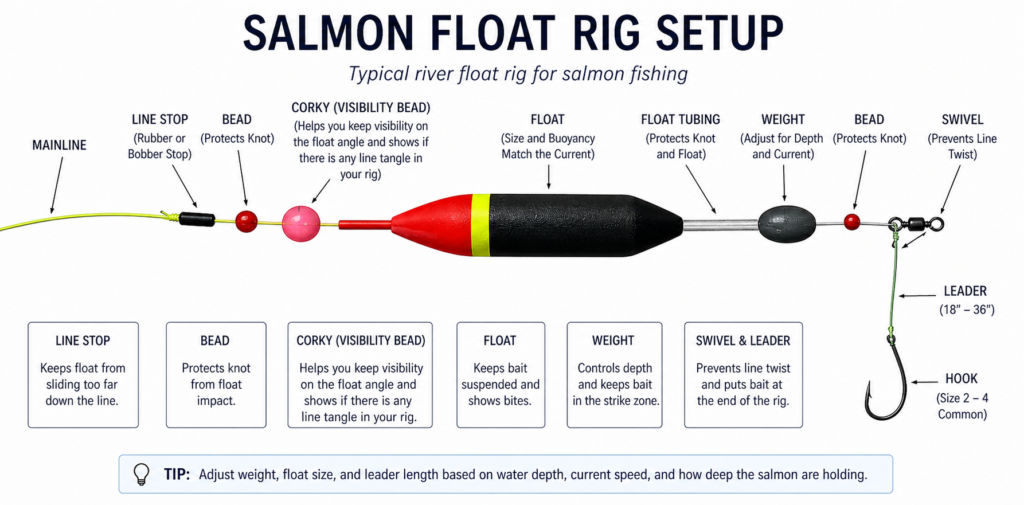
Float fishing is one of my favorite ways to target Chinook from the bank, and it is where I would tell most beginners to start.
It lets you present bait naturally through seams, slots, tailouts, and travel lanes while giving you real control over depth. When the water is deep enough and the current allows a clean drift, bait under a float is hard to beat for Chinook.
A basic salmon float setup includes:
- Bobber stop
- Bead
- Corky
- Sliding float
- Weight
- Second bead
- Swivel
- Leader
- Hook
- Bait
The goal is to drift your bait naturally through the lane. Not dragging bottom on every cast, but not riding so high that it is floating above the fish either. Your float should track with the current, moving at the same speed as the lane you are fishing, not tilting hard or ripping sideways.
One thing beginners often get wrong with float fishing is setting the depth incorrectly for the water they are actually fishing. The depth on your float needs to match the depth of the lane, not just an approximate guess.
In a run that is eight feet deep, a float set at four feet is fishing half the water column above the fish. Take the time to adjust until your bait is consistently reaching the bottom third of the water column where Chinook hold.
The weight you use matters too. You want enough weight to get the bait down efficiently, but not so much that it drags the bait unnaturally or kills the drift. A bait that sinks too fast can look wrong. A bait that drifts at the same speed as the current and settles naturally into the zone looks right.
For Chinook, I want the bait running in the bottom third of the water column. That is where the fish typically are, and that is where your presentation needs to be.
For the full rig breakdown, my salmon float rig setup guide covers it in detail. For hooks, weights, beads, swivels, and other small components, my terminal tackle for salmon fishing guide covers the complete system.
Drift Fishing Setup
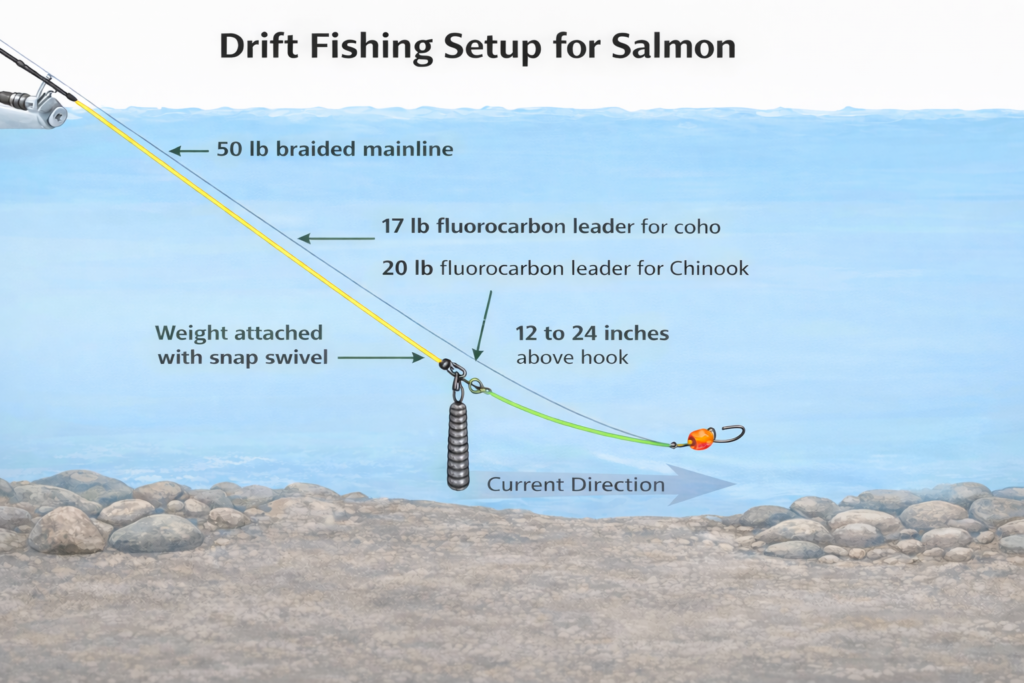
Drift fishing can also be very effective from the bank, especially when you are fishing defined slots, seams, or current edges where you can get your rig ticking naturally through the lane.
The idea is simple: cast slightly upstream, let your weight find the bottom, and drift your bait or presentation through the zone with controlled bottom contact.
You want the rig ticking along at roughly the speed of the current. Not dragging like an anchor, not floating too high. Just enough bottom contact to know you are in the zone.
A basic drift fishing setup includes your mainline, a weight or dropper setup, a swivel, leader, hook, and bait, whether that is eggs, shrimp, corky and yarn, or a combination.
One important detail beginners often miss with drift fishing is the dropper setup. Many experienced drift anglers use a separate dropper line with lighter monofilament to attach the weight instead of tying the weight directly to the mainline. The reason is simple. When the weight snags, the lighter dropper can break first and you lose the weight but save the hook, leader, and bait.
Losing a piece of pencil lead is a lot better than losing the whole rig.
Leader length in drift fishing also matters more than people think. Too short a leader and your bait is riding right next to the weight, which can look unnatural and spook fish. A leader somewhere in the 18 to 36 inch range is a common starting point for Chinook drift fishing, with adjustments based on water clarity and current speed.
Drift fishing from the bank is not about bombing random casts across the river and hoping something happens. It is about putting the rig in the right lane with the right weight and letting the current do the work.
Too much weight and you are hanging up constantly. Too little and you are never actually fishing the bottom where the fish are.
For the full technique breakdown, my guide on how to drift fish for salmon goes through the whole approach.
Lure Fishing Setup
Lures are not always my first choice for Chinook, but there are plenty of situations where they are the right call, and having them in the bag matters.
Spinners, spoons, twitching jigs, plugs, and soft beads can all catch Chinook from the bank. Lures make the most sense when you need to cover water quickly, fish a travel lane efficiently, or try to trigger a reaction bite from fish that are not responding to bait.
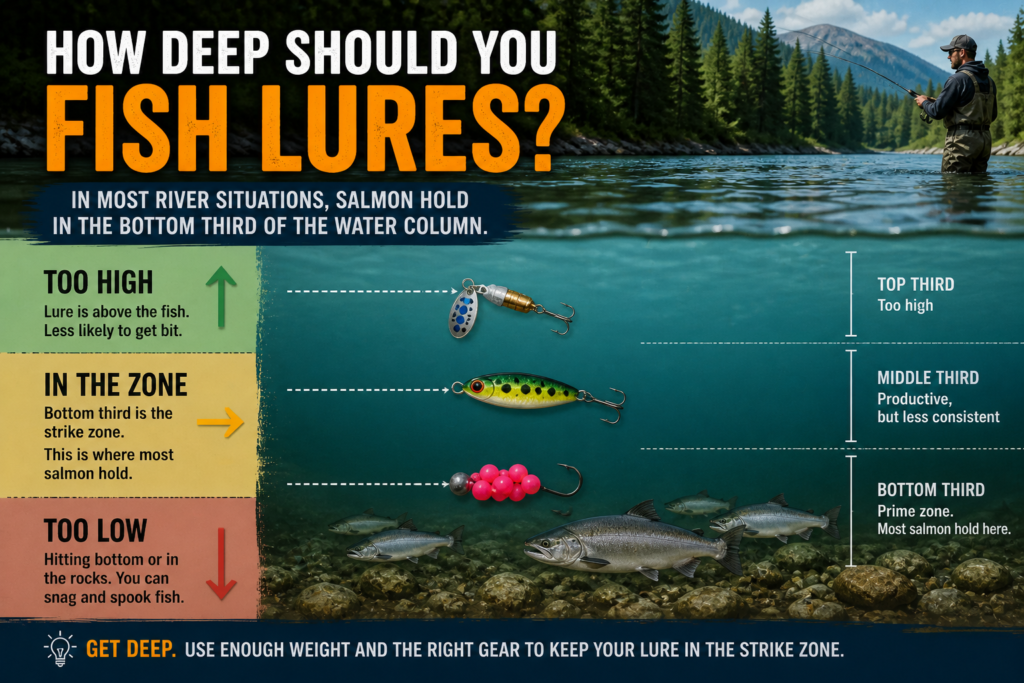
The biggest mistake beginners make with lures is fishing them too fast and too high.
A spinner needs to get down and swing through the lane, not ride over the fish’s head. The blade needs to be turning, but the lure also needs to be in the zone. If you cannot occasionally feel the lure working near the bottom, it may be too high.
A spoon needs time to sink and wobble naturally through the current.
A twitching jig needs to actually fall into the zone on a semi-slack line, because most bites happen on the drop, not the lift.
If your lure is above the fish all day, the color does not matter.
For a full breakdown of lure techniques, my guide on how to fish salmon with lures covers each style in detail. If you are still deciding what to carry, my best salmon lures for river fishing guide covers the main lure types.
Line and Leader Setup
Chinook are not the fish to target with underpowered line, and that is not an exaggeration.
For most bank fishing setups, strong braided mainline paired with a fluorocarbon leader is the standard starting point. A lot of salmon anglers run braid in the 40 to 65 lb range depending on the river, technique, and current strength. Leader size typically falls around 20 to 30 lb fluorocarbon for Chinook, with adjustments for water clarity, pressure, and fish size.
Fluorocarbon is preferred by a lot of salmon anglers because it is less visible than many other leader materials and has good abrasion resistance. That matters when you are fishing around rocks, gravel, wood, and heavy fish in moving water.
One thing worth noting on braid: high-visibility braid colors like neon yellow, chartreuse, or orange can be fine for the mainline because you are running a fluorocarbon leader between the braid and your terminal tackle. The fish rarely sees the braid itself, and high-visibility colors help you track your line and manage the drift more effectively.
For float fishing, heavier braid helps with line control and mending. For drift fishing, you need enough strength to fight a big fish but enough sensitivity to feel bottom contact. For lures, your line and leader need to match the size of the lure and the water you are fishing.
For more detail, my guides on best braided fishing line for Chinook salmon and best leader line for Chinook salmon break down the specific options.
Best Bait for Chinook Salmon from the Bank
If I am specifically targeting Chinook from the bank, bait is where my confidence starts, and it has been that way for a long time.
Chinook respond well to scent. Even though river Chinook are not actively feeding the same way ocean fish are, they still have strong scent response. Familiar scents, especially eggs and shrimp, can trigger a response even from fish that have no interest in chasing hardware.
A good bait presentation can stay in the strike zone longer than most lures, drift more naturally, and give a fish sitting in a deep slot a real reason to commit.
Good Chinook baits include:
- Cured salmon eggs
- Sand shrimp
- Coon shrimp
- Egg-and-shrimp combos
- Tuna belly chunks
- Scented bait presentations
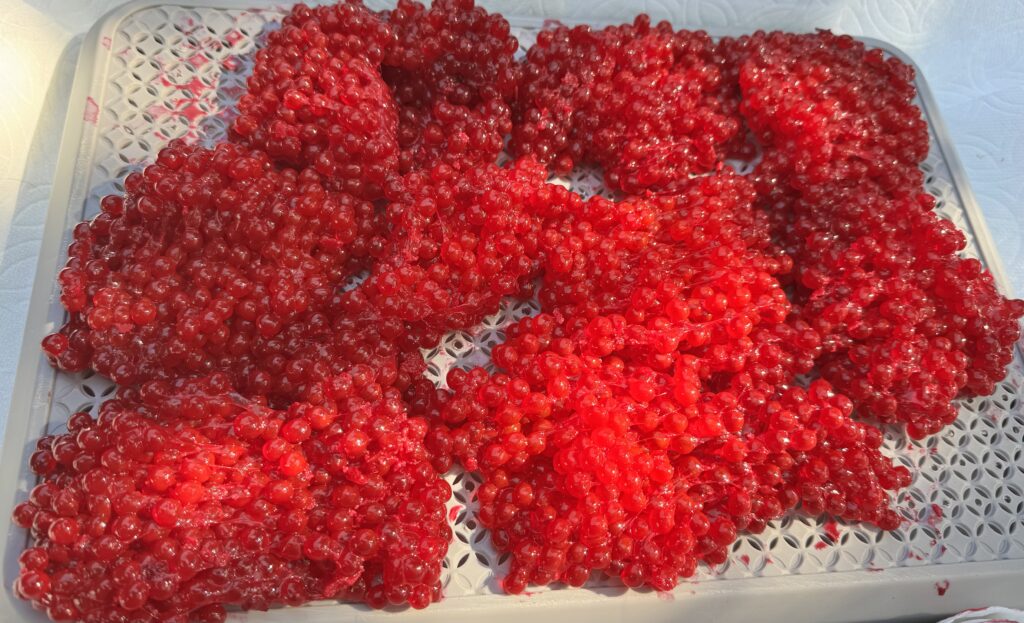
Cured eggs are the classic for good reason. A well-cured cluster drifting naturally through the bottom of a seam or slot is one of the most effective Chinook presentations there is.
The curing process does more than preserve the eggs. It firms them up so they stay on the hook longer, and different cure recipes can change the color and scent profile to match what fish are responding to on a given river or day.
Pink and orange cures are common all-around starting points, while brighter chartreuse or red cures can be worth trying in stained water or when fish have seen a lot of standard-colored bait.
Sand shrimp and coon shrimp are both strong options on their own, and the egg-and-shrimp combo is one of those setups I keep coming back to when fish are being picky. The combination of egg scent and shrimp profile covers multiple triggers at once, which can be the difference on a tough day.
Tuna belly, while less commonly talked about, is worth having in the rotation. It is an oily, scent-heavy bait that can work well in off-color or higher water when you want something with strong scent dispersal.
I also like adding scent when it makes sense. Chinook can be very scent-driven, and sometimes a small change in the scent profile is what tips a fish from ignoring the bait to eating it.
But here is the thing: the bait itself is only part of the equation.
A perfect bait drifting too high, too fast, or outside the lane is not doing much. A simple bait drifting naturally through the bottom third of the right seam has a much better chance than the best-looking bait in the world running five feet above the fish.
For more bait-specific detail, read my guide on the best bait for Chinook salmon. If you are fishing eggs, my guide on how to rig salmon eggs will help you keep your presentation working correctly. I also have guides on best salmon egg cures and best salmon fishing scents if you want to dial in that side of things.
Best Lures for Chinook Salmon from the Bank
Lures absolutely have their place for bank fishing Chinook, and I do not want to undersell them.
I generally prefer bait when I am grinding out a Chinook bite, but there are plenty of days when lures make more sense. If bait is not getting touched, if I need to cover water, or if fish seem to be moving through a run without stopping, I will reach for hardware.
Spinners are good for covering seams, current edges, and travel lanes. The flash and vibration combination is hard for salmon to ignore, especially in lower-visibility water. For Chinook specifically, I am usually thinking in the larger size range, often a #4 or #5 blade for most water, sizing up in bigger or more turbid conditions. When I can feel that blade working through the rod and the lure is swinging naturally through the zone without riding too high, I have confidence in it.
Spoons can be excellent in bigger water where they have room to swing and wobble through the lane. The key difference between a spoon and a spinner is that spoons rely more on flash and wobble without the added vibration of a spinning blade. That can actually be an advantage on pressured water where fish have seen a lot of spinners. A spoon gives them a different look and action.
Do not think of spoons as simple cast-and-reel lures. The casting angle, sink time, and swing all matter just as much as they do with other salmon presentations.
Twitching jigs work well in slower holding water, deeper pools, and softer edges. Anywhere you can work the jig through a defined zone and keep it in front of fish that are sitting rather than traveling.
The lift-and-drop action triggers that reaction response river Chinook still have even when they are not feeding.
Plugs are worth having when current can help them dig and hold in front of fish. What makes plugs useful is that they can stay in the strike zone longer than some other lure styles. The current does the work of keeping the plug action going. Bait-wrapping plugs with herring or sardine can add scent to the visual trigger, which can improve results.
Soft beads give you an egg-style presentation when you want something subtle without dealing with real bait. They are particularly useful when fish are keyed in on eggs but have seen a lot of standard bait presentations.
For the full lure breakdown, my best salmon lures for river fishing guide covers each type in detail. I also have dedicated posts on the best spinners for salmon fishing and best spoons for salmon fishing if you want to go deeper on either of those.
How Deep Should You Fish for Chinook Salmon?
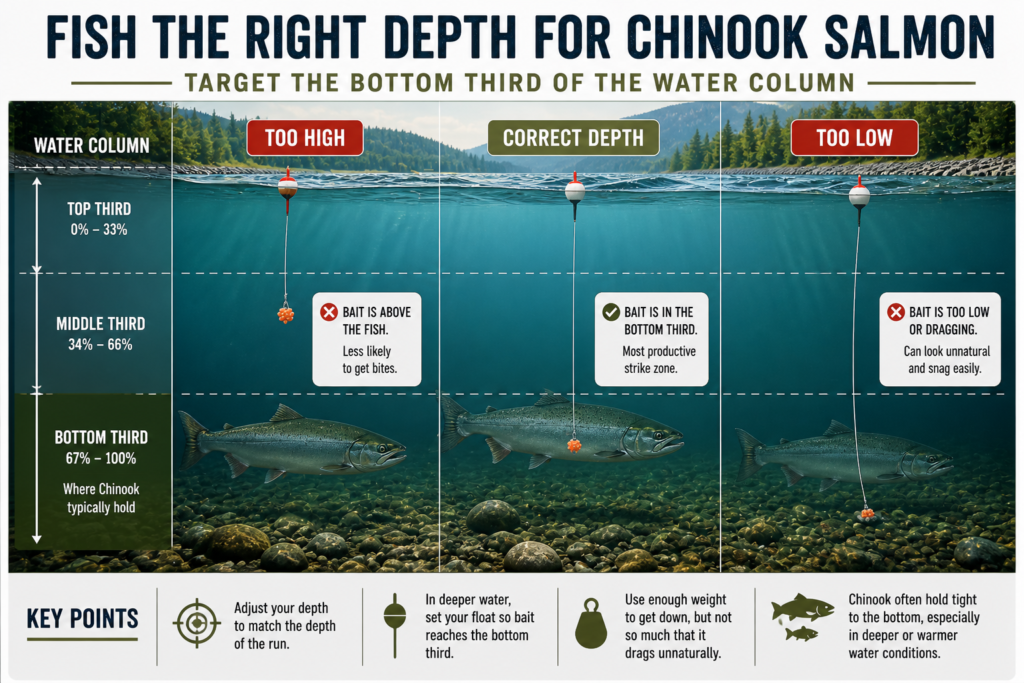
Most beginners fish too high.
It is probably the single most common reason people do not catch Chinook when the fish are actually there.
They might be in the right area, using decent bait, fishing a real seam, and still going home empty because the presentation is riding above the fish the whole time.
Chinook often hold in the bottom third of the water column in many river situations, and in deeper or warmer water they may push even lower, tight to the bottom in the deepest available part of the lane.
That does not mean you need to drag bottom on every cast, but your bait, drift rig, or lure needs to get down close enough that a fish actually sees it.
Water temperature can play a role in depth too. Chinook are cold-water fish, and they generally become tougher to catch and harder to safely release as river temperatures climb. In warm conditions, fish often push into deeper, cooler holding water and become less willing to move for anything. In those situations, getting your presentation down into the deepest part of the slot becomes even more important.
For float fishing, this means setting your depth so your bait reaches near the bottom without constantly snagging. In deeper or faster water, you need to cast far enough upstream that the bait has time to sink before it hits the best part of the lane. If your float is still pulling the bait down when it is already past the seam, you are wasting the drift.
For drift fishing, you want controlled bottom contact. Ticking is exactly what you are after. Dragging hard and hanging up every few casts means you are too heavy or too slow. Never feeling bottom means you are probably not in the zone.
For lures, give them time to sink before you start the retrieve. A lot of people cast a spinner or spoon and start reeling before the lure has come anywhere close to where the fish are holding. Let it get down first. Count it down if you have to. Cast, count a few seconds, then start the retrieve. That habit alone can make a big difference.
If your presentation is above the fish all day, it does not matter how good it looks.
For a more detailed breakdown, my salmon float fishing depth guide covers depth control specifically.
When Is the Best Time to Bank Fish for Chinook?
The honest answer is that the best time depends on the river, the run timing, water conditions, and regulations. But there are patterns worth paying attention to.
Low light is almost always better than bright midday sun. Early morning and evening can both be productive, especially when fish are moving through shallower travel lanes or transitioning between holding spots. The low light gives fish more confidence to move through less-protected water, and it can also make them more reactive to both bait and lures.
Overcast days can also fish well throughout the day for similar reasons. Direct bright sunlight on a clear river can push fish tight to the bottom and make them much harder to provoke.
Water and weather changes matter too. A bump in river level after rain can bring fresh fish in or get fish that have been sitting to move again. Blown-out, muddy water can shut things down completely. Most salmon lures and bait need at least some visibility to work effectively. Slightly stained or off-color water, on the other hand, can actually be productive because it gives fish more confidence and makes them less cautious.
Run timing is one of the most important factors of all, and it gets overlooked by a lot of beginners.
Chinook runs are river-specific and often broken into early, peak, and late-run timing windows that vary a lot by watershed. Fishing during peak run timing, when the most fish are actively moving through, matters more than almost anything else. Knowing the specific run timing for the river you are fishing is worth researching before you go.
Things I pay attention to:
- Early morning and evening windows
- Overcast days
- Cooler water temperatures
- Fresh rain after a low-water period
- River levels rising or dropping into fishable shape
- Water clarity
- Seasonal run timing
- Tide influence in lower tidal sections of rivers
Always check current regulations before you go. Salmon seasons, retention rules, bait restrictions, hook rules, and closures can all change by river and date. Do not assume what was legal last year still applies.
For a deeper timing breakdown, read my guide on the best time to fish for Chinook salmon.
How to Fight and Land Chinook from the Bank
Hooking a Chinook is only half the job, and a surprising number of fish are lost in the last ten feet of the fight.
That is when anglers get excited, high-stick the rod, rush the fish, or try to drag a green salmon into the shallows before it is anywhere close to ready. I have done it. Most people have.
When you hook a Chinook from the bank, the most important thing is to stay calm and keep steady pressure. Let the rod do what it is designed to do. Do not point it straight at the fish. That removes all the rod’s shock-absorbing ability and puts direct pressure on the hook and knot, which is where things break. But do not lift so high that you risk a broken tip or a popped hook either. Keep the angle somewhere in between and maintain contact.
Setting the drag correctly before you start fishing is something a lot of beginners skip. Your drag should be set so it releases line under sustained pressure before the line reaches its breaking point. Too tight and a hard run can break the leader. Too loose and you cannot control the fish near the bank.
If the fish runs, let the drag work. That is what it is there for. Do not try to thumb-stop the spool or clamp down on the line when a big Chinook decides to make a run. That is how leaders get broken and how fish are lost.
If you can safely move with the fish, move. Step downstream or reposition on the bank if it helps. Sometimes that is smarter than trying to stop a big Chinook in heavy current by force.
Side pressure is a useful tool during the fight. Instead of pulling straight back, angling the rod to the side creates more leverage and can help turn the fish. Switching rod angles during a long fight can also keep the fish off-balance and prevent it from sitting in the current.
When the fish gets close, do not rush it. A green Chinook at your feet still has a hard run or two left. Lead it toward softer water when you can, keep the pressure steady, and wait until the fish is genuinely tired before you make a move with the net.
Speaking of the net, a good one matters a lot from the bank, especially around rocks, riprap, steep edges, or fast current. I want a big oblong hoop, a deep bag, and a long handle. Net the fish head-first, hold the net steady, and let the angler lead the fish in instead of chasing it around. Chasing almost always ends badly.
If the fish has to be released, keep it in the water as much as possible. Use the net to control it while you remove the hook, support the fish upright in the current, and let it kick away on its own. A quick, careful release is always better than dragging the fish onto rocks or holding it out of the water longer than necessary.
Sharp, strong hooks are also part of this equation. A big Chinook will find every weak point in your terminal setup, and a dull or undersized hook is one of the most common ones. My best hooks for salmon fishing guide covers size, strength, and style in more detail.
Common Beginner Mistakes
Most Chinook mistakes are simple. They are also responsible for a lot of lost fish.
Fishing Too High
This is the biggest one.
If your bait or lure is riding above the fish all day, you are not really in the game. Adjust your float depth, sink time, lure angle, or weight before you decide the fish are not biting.
Casting Randomly
Random casting feels like you are covering water. Usually you are not covering much of anything useful.
Work the run in lanes: close, middle, far. Focus on seams, slots, tailouts, and soft edges. My guide on where to cast for salmon in a river covers this in detail.
Using Gear That Is Too Light
Chinook are big, strong fish and they will find the weakest link in your setup fast.
A light rod, weak leader, cheap hook, or underpowered drag may work fine until the first real fish shows up. Check your drag setting before you start fishing, not after you have broken off.
Changing Bait Too Often
Sometimes the bait is not the problem.
Before you swap bait every ten minutes, adjust your depth, drift speed, leader length, casting angle, and lane. Good bait in the wrong water is still the wrong presentation.
Standing in the Travel Lane
This one costs people fish constantly.
They walk straight into the soft inside lane to reach the far bank, not realizing Chinook were using that exact path. Fish the close water before you ever step into it.
Fishing in Water That Is Too Warm
This one gets overlooked a lot.
Chinook can become stressed and much harder to release safely when river temperatures climb. In warm summer conditions, check the water temperature before you fish. Many rivers post real-time temperature data, and some fisheries close or restrict fishing when conditions get too warm.
Fishing for and fighting Chinook in very warm water can reduce survival odds after release, especially if the fish is played too long or handled poorly.
Not Checking Regulations
Some rivers have barbless hook requirements, bait restrictions, wild fish release rules, or seasonal closures. Always check your local fish and wildlife regulations before you make a single cast.
Do not guess.
Trying to Land Fish Without a Net
Sometimes you can beach a hatchery fish on an easy gravel bar. A lot of the time, trying to hand-land or drag a big Chinook from rocks or a steep bank is how fish get lost right at the end.
If you bank fish regularly, a good salmon net should be standard equipment.
Final Thoughts
Learning how to catch Chinook salmon from the bank is not about one trick or one secret bait.
It comes down to fishing the right water, getting your presentation deep enough, using gear that is up to the job, and staying patient through the slow stretches. Chinook can be genuinely frustrating fish. They do not always bite just because they are there. But if your bait or lure keeps passing through the right lane at the right depth, your odds go up considerably.
If I were starting from scratch, I would focus on bait under a float, learn how to read seams and slots, dial in my depth, and carry a few lures for covering water or changing things up when bait is not producing. I would also make sure my line, leader, hooks, and net were all strong enough before I ever hooked the fish.
Most beginners do not need more gear. They need a simple plan and the patience to fish it right.
If you want to keep building the full system, my complete salmon fishing setup for rivers, bank fishing for salmon, and best bait for Chinook salmon guides are all good next reads.
FAQ
What is the best way to catch Chinook salmon from the bank?
The best way to catch Chinook salmon from the bank is to fish known travel lanes and holding water with the right depth and a strong setup. Bait under a float is one of the best starting methods when legal. Cured eggs, shrimp, or an egg-and-shrimp combo in the right lane at the right depth is hard to beat for Chinook.
What bait is best for Chinook salmon from shore?
Cured salmon eggs, sand shrimp, coon shrimp, and egg-and-shrimp combos are all strong options. Scent and bait quality matter, but depth, drift speed, and fishing the right lane matter just as much, if not more.
How deep should I fish for Chinook salmon?
Most Chinook salmon presentations should run near the bottom third of the water column. In warmer water conditions, Chinook often push even deeper into the coldest available water. If your bait, drift rig, or lure is riding too high, you can be in the right area and still go home without a fish.
What lures work for Chinook salmon from the bank?
Spinners, spoons, plugs, twitching jigs, and soft beads can all work for Chinook salmon from the bank. Lures are especially useful when you need to cover water, fish travel lanes efficiently, or trigger a reaction bite from fish that are not responding to bait.
Where do Chinook salmon hold in rivers?
Chinook salmon typically hold in deep slots, pools, seams, tailouts, and softer current edges near travel lanes. They prefer water where they can rest without fighting the heaviest current, and in warmer conditions they often seek out deeper, cooler water.
What line should I use for Chinook salmon from the bank?
Strong braided mainline with a fluorocarbon leader is a good starting point for Chinook salmon from the bank. Many bank anglers run 40 to 65 lb braid with a 20 to 30 lb fluorocarbon leader, adjusted for water clarity, technique, and fish size.
Is float fishing good for Chinook salmon?
Yes, float fishing is one of the best bank methods for Chinook salmon because it lets you present bait naturally through seams, slots, and travel lanes while giving you real control over depth.
What is the biggest mistake beginners make fishing for Chinook salmon?
Fishing too high or in the wrong lane is usually the biggest mistake. Before you change bait or lures, adjust your depth, casting angle, sink time, and presentation. A good bait or lure in the wrong water or at the wrong depth is still the wrong presentation.